Saturday, 20 October 2012

Vin Primeur 2012 apero time


Clochers and Terroirs is an enormous operation by any standards. Eleven central Hérault valley villages have combined forces and now represent some 850 grape growers with 2,800 hectares of vines. Production is 200,000 hl that equates to over 26 million bottles, although most will go into popular 10 litre BIBs.


Every other cooperative seems to make Vin Primeur these days. At Clochers and Terroirs the launch of the new vintage is an opportunity for villagers to have a convivial apero or three and be subjected to mercifully brief thank you speeches.

The cave at Nébian could easily host a tennis match plus audience in the space surrounded by dozens of now defunct double-decker cuves.

As for the wine itself, it avoids overdoing heady carbonic maceration induced fruit and has a pleasant dry and slightly tannic adult finish. That said, analysing it isn't really the point. Given that this year's harvest is down 25%, at least in one of the communes, it was a very generous event.

Thursday, 18 October 2012

150 Years of Languedoc grape varieties

The Béziers médiathèque is an impressive new building just to the east of the town centre. An exhibition "150 years of grape varieties in the Languedoc" has a display of lithographs of grape varieties by Henri Marès published in 1890. This is one of them.


My translation "Probably a very old variety originating from the Bas-Languedoc.
Long living, the aspiran variety displays an elegant poise and shape in its leaves and bunches. In the departments of the Bas-Languedoc it is [in 1890] usually the preferred table grape for eating. It is delicious and wholesome and very moreish, one can east vast quantities. No other variety is lighter, more agreeable and easier to digest".


Aspiran is a small village just off the Hérault valley in the Pézenas appellation (I also have a blog on the village Aspiran Postcard). To my knowledge this is the only French planted grape variety named after a local place, or at least a small village (Syrah derives from Shiraz in Persia, now Iran). Today Aspiran seems to be better known under the synonym Ribeyrenc, but that said the grape is seriously rare with just a handful of vines growing in a few Languedoc domaines. It seems following the phylloxera epidemic and frosts of 1956 the variety was not replanted.

A big hope is Domaine Thierry Navarre at Roquebrun who has rescued and grafted some vines and is now making a Ribeyrenc. I now need to seek this out.

Other references I have found are Wikipedia en.wikipedia.org/wiki/Aspiran_Noir
And a fiche in French from INRA

The dossier on the médiathèque exhibition is here (for now) dossier-cepage.pdf

Wednesday, 17 October 2012

Grand new order revisit #2

My final words on my last post on this subject were "I suspect it may be less than 8 months before returning to this topic". Life flies by - it was 18 months ago I typed this. To be frank, I'd also lost interest in the matter.

Rosemary George gave an update on her blog here nearly a year ago; essentially that INAO don't like the term Grand Cru for the Languedoc leaving Cru at the top of the pyramid, plus there is the idea of creating a Terroir d’exception below Cru. However, Terroir d’exception can't appear on labels, so it all seems a bit naff and to me sounds more important/prestigious than Cru. Never mind, since then almost total radio silence on the matter has prevailed.

The absence of news seems to be confirmed by this "the drinks business" article that indicates no official change since Rosemary's piece, assuming the article was recently researched of course. The only "news" is that Faugère, 30 years after being awarded AOC status, has unofficially declared itself as Faugères: grand terroir de schiste. Like schist, perhaps things are starting to fracture.

Tuesday, 2 October 2012

The way it once was - Domaine de la Tour

Les Journées Européennes du Patrimoine are an excellent opportunity to see and learn about places not usually open to the visiting public. I knew of Domaine de la Tour (Nebian in the middle Hérault valley) as somewhere for concerts, art expositions and big private parties. I'd also cycled through the building complex that sits atop a modest hill overlooking the middle Hérault valley just south of Clermont l'Hérault.


Like most grand estates in the Languedoc, Domaine de la Tour would have been funded by profits from wine production during one of the boom periods for the region. While still surrounded by vineyards, these days the grapes are all destined for the local co-operative. Nevertheless, much remains of what once was.


The theme of the day was was a guided tour of the features for managing water on the estate. Most impressive was a pumping house above a well that housed an early 20th century electric pump once used to plenish a water tower above the winery over 200 meters away. Although now dismantled, the old water tower is clearly visible at the left end of the old photograph.

The chai is still lined with 35 wine barrels that each held 280 hl giving a capacity of over a million bottles. In the days before de-stemmers, pumps and pressure hoses a great deal of water would have been needed for cleaning.


Also in the chai is an interesting museum space with various bits of "vintage" equipment artefacts, old photographs and other memorabilia.


Monday, 24 September 2012

Home made grape juice (and natural wine)

One of the best alternatives to wine, especially at breakfast, is decent grape juice. It also goes brilliantly with muesli.

Inspired by a friend while picking grapes this is my version.


1. Pick some organic grapillons with the permission of the vigneron. Grenache or Carignan from Mas Gabriel are perfect. Grapillons are small bunches from later flowering and are less sweet than ripe bunches. More importantly, vignerons don't generally pick them as their unripe green tannins makes red wine bitter.


2. De-stem the grapes in a clean bowl. Fingers are good at this.


3. Blend the grapes in a blender. This is quick but aggressive - quite a few skin tannins will be extracted.
For a gentler approach try treading them with your feet.


4. Sieve into a bowl. The juice can then be bottled (used plastic mineral water bottles or similar are ideal) and stored in the fridge.


The remaining skins, pips and stalks can be spread on the vineyard, although technically they should be left in a designated place to be collected by the local distillery.

Note that following has not been attempted by the author.

To make a natural wine use ripe grapillons and after step 4 just allow the juice to ferment. You don't need to add anything else as I'm told it won't be natural, although bio yeast nutrients are acceptable. Using a closed glass fermentation vessel like a demijohn should reduce the risk of the fermentation going wrong.

The above makes deep rosé, although rosé from Carignan will look like red wine.

To make a deeper red wine wine delay step 4 by a couple of weeks but be careful not to over extract. For white try white grapillons. For sparkling wine simply use a pressure proof bottle and omit the fridge bit of step 4.

Bon chance.

Wednesday, 19 September 2012

Pressing matters

This is the first time I've seen a pneumatic or membrane press in action. A team of 8, including me, took 7 hours without a lunch break to pick a full load of 30 hl. Whole bunches of Terret, mainly blanc with some gris, go on a conveyor to fill the press from the top. After a 2.5 hour cycle juice for around 2,000 bottles had been extracted.

Regis Pichon (Domaine Ribiera) and Emile Heredia (Domaine des Dimanches) load the conveyor
The machine is a cylinder that works by inflating a long membrane that gently presses the grapes against perforated ridges on the opposite side. The resulting juice collects in a tray underneath and is pumped away. For an excellent short explanatory video by Charles Simpson of Domaine Sainte Rose look here on YouTube.

David Caer (Clos Mathelisse) loads the press
The press is shared between several small wine makers in Aspiran, part of the Pézenas terrior. This model would cost over €20,000 even second hand so realistically isn't affordable for start-up vignerons.

The juice collects underneath and is pumped into a cuve.
For Domaine Ribiera this is the last harvest bar some minute quantities of late harvest Grenache and Clairette. Terret is a relatively late ripener, especially as most of these grapes were picked from north east facing parcels. The potential alcohol is just over 10% with plenty of acidity.

Sunday, 16 September 2012

Fons Sanatis Reds


I was so impressed last year with the Domaine Fons Sanatis B… d’Agniane 20.09 (a Vermentino) that on spotting some reds from the Domaine in a caviste I didn't hesitate to give them a punt.

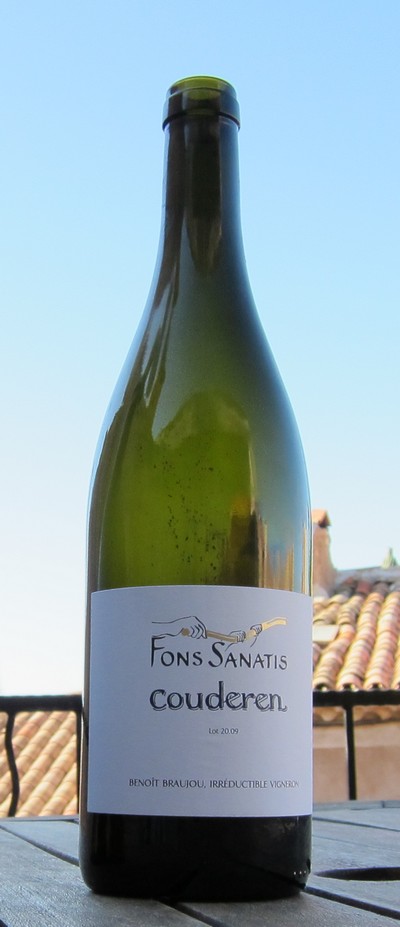
Fons Sanatis Couderen 20.09 turns out to be Merlot and Cabernet Sauvignon. Had I known this my bias against producing a Bordeaux blend on such prime terroir would have vetoed the purchase.

Dark, brooding and concentrated without much Cabernet blackcurrent but plenty of classic Merlot fruitcake. Good acidity. Really quite hard tannins are prominent and coat the mouth. Challenging, or at least a shock, to drink on its own but with Merguez sausages laced with harissa followed by cheese it stood up and interplayed brilliantly. Not at all Bordeaux in style is has a herbal streak to it. I also couldn't detect any change to the wine the next day.

If I had another bottle I'd keep it years with the hope it would layer itself out, but I won't be buying any to lay down. Around 12€.

Another bottle in the selection was Senescal L’Art Amont 20.09 I took along to a vendanges lunch. The grape is Aramon, a variety that was once a monster yielding workhorse of the Languedoc. Today it's unheard of which is curious given that in 2008 there were 1719 Hectares of the stuff in the Hérault which amounts to 1.8% of the land under vine. By comparison this is comfortably more than Picpoul and Viognier. It's a hard wine (apparent unoaked) that reminded me of Vin de Table from early holidays in France back in the 1970s. This 2009 version eliminates the rustic and volatile characteristics of those days, but at 15€ is of course seriously priced. I look forward to trying it in slightly more analytical circumstances.